How to Build a Skincare Routine Without the Overwhelm

A skincare routine that works has three steps, not twelve. Open any social feed and a twelve-step shelf stares back at you. Serums line up like soldiers. Each bottle promises the glow the last one missed.
Dermatologists keep saying the opposite. Yale dermatology professor Kathleen Suozzi told the Associated Press that skincare regimens have become “way overcomplicated.” Extra products often cause the redness and breakouts that people then buy more products to fix.
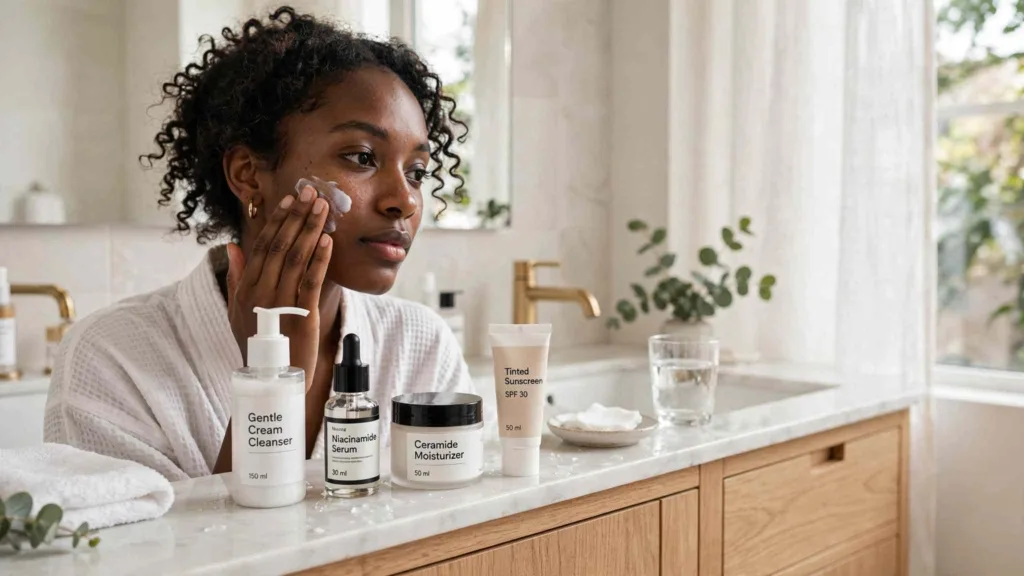
This guide takes the other path. You will start with three products and learn the morning and night order. Then you will add extras one at a time, only if your skin asks. No crowded shelf. No guessing. A simple skincare routine you can keep for years. A skincare routine means cleansing, moisturizing, and wearing sunscreen each morning, then cleansing and moisturizing again at night.
Why Most Skincare Routines Fail Before They Start
Most people quit in week three. The cause is rarely the products themselves. It is starting with six of them at once.
One new bottle can sting, pill, or trigger a breakout. With six new bottles, you cannot name the culprit. So people dump the whole shelf and decide skincare is not for them. Dermatologists see this pattern often. Multiple new products can stress the skin barrier and hide which ingredient caused the reaction.
Learning how to build a skincare routine is mostly learning what to skip. Start with three products. Learn your skin’s baseline first. Add from there, slowly.
Do a quick shelf audit before you buy anything. Line up every product you own. Keep the gentle cleanser, the plain moisturizer, and the sunscreen you will wear. Set aside the rest for now. You are not wasting them. You are giving your skin a clean baseline to report from.
The 3-Step Core Every Skincare Routine Needs
Every working routine rests on three jobs. Clean the skin. Keep water in it. Shield it from the sun. These three steps deliver most of what daily skincare can do.
Three drugstore staples usually cost less together than one luxury serum. Price often reflects packaging, not performance. Start affordable and upgrade only what disappoints you.
Step 1: Cleanse Gently
Wash with a gentle cleanser and lukewarm water. Hot water strips the natural oils that keep skin calm. Massage for about thirty seconds, then rinse. Pat dry with a clean towel. Never scrub.
Dry or sensitive skin often prefers a cream or milky cleanser. Oily skin usually likes a light gel instead. Your face should feel comfortable after rinsing. Tight and squeaky means the cleanser is too harsh.
Step 2: Moisturize While Skin Is Damp
Apply moisturizer within a minute of washing. Damp skin gives humectants like hyaluronic acid and glycerin water to hold. This single habit can matter more than the brand you buy.
Look for ceramides or squalane on the label. Both support the skin barrier through the day. Use a pea-sized amount for the face. Press it in with your palms instead of rubbing.

Step 3: Protect Every Morning
Sunscreen goes last every morning, without exception. UV light drives most visible aging. It reaches you through clouds and office windows too. Dr. Oyetewa Asempa directs the Skin of Color clinic at Baylor College of Medicine. She told the Associated Press that nine out of ten facial concerns she treats are worsened by UV radiation.
Choose a broad-spectrum SPF 30 or higher. A two-finger strip of product usually covers the face and neck. Reapply every two hours when you stay outdoors, and sooner after swimming or sweating.
Morning vs Night: The Only Split That Matters
You do not need two different routines. You need one routine with a morning ending and a night ending. Mornings defend against the day. Nights repair while you sleep. Travel, seasons, and stress can shift what your skin needs. The three steps stay put. Only the textures and extras change.
Your Morning Order
Cleanse or rinse, moisturize, then sunscreen. That is the whole list. Dry skin can skip the morning cleanse and rinse with water. A vitamin C serum can slot in before moisturizer once the basics feel stable. It pairs well with sunscreen. For the full breakdown, see our morning skincare routine guide. This matches the dermatologist-recommended basic skin care steps from the American Academy of Dermatology.

Your Night Order
Cleanse, then moisturize. Skip sunscreen at night. Long-wear makeup or waterproof sunscreen needs a first pass with a cleansing oil or balm. Follow with your regular cleanser. This double cleansing clears the day without harsh scrubbing. Night is also when treatments like retinoids belong, but only after the basics feel boring. Our night skincare routine walks through the evening order step by step.
The Upgrade Ladder: Add One Thing at a Time
A skincare routine for beginners should grow slowly. Add one product and wait two weeks before the next. This ladder shows a sensible order. Stop at any rung that feels complete.
Level 1: Add a Hydrating Toner
A thin hydrating layer after cleansing suits dry or dehydrated skin. Look for glycerin or hyaluronic acid on the label. Skip this level if your moisturizer already keeps you comfortable all day.
Level 2: Add One Targeted Serum
Pick one concern and one serum. Niacinamide helps with oil and uneven tone. Vitamin C targets dullness and dark spots. Apply it after cleansing and before moisturizer. Give it a full month before you judge the results.
Level 3: Add Exfoliation Twice a Week
Chemical exfoliants like AHAs and BHAs loosen the bonds between dead skin cells. Start with two evenings a week, never daily. Salicylic acid suits oily, breakout-prone skin. Lactic acid tends to be gentler on dry skin. Skip exfoliating on nights you use a retinoid.
Level 4: Add the Extras
Eye cream helps if concealer creases or the area feels dry. A face oil pressed over moisturizer can seal hydration on very dry nights. These are comfort upgrades, not requirements. Many people never need them, and that is fine.
Match the Steps to Your Skin Type
The three steps never change. The textures do. Use this table to tune a basic skincare routine to your skin.
| Skin Type | Cleanser Pick | Moisturizer Pick | Watch Out For |
|---|---|---|---|
| Dry | Cream or milky cleanser | Rich cream with ceramides | Foaming washes and long hot showers |
| Oily | Gentle gel cleanser | Lightweight gel or lotion | Skipping moisturizer; harsh scrubs |
| Combination | Gentle gel cleanser | Lotion, plus richer cream on dry zones | Treating the whole face as one zone |
| Sensitive | Fragrance-free cream cleanser | Simple barrier cream, no fragrance | Strong exfoliants and new actives |
Combination skin confuses people the most. Treat the T-zone and cheeks as separate areas. A light layer everywhere, plus extra cream on dry cheeks, often solves it.
The Patch Test Rule

New product, new patch test. Dab a small amount behind your ear or along the jawline. Wait 24 to 48 hours. No redness, itching, or new bumps means it can go on your full face.
This habit saves more skin than any ingredient trend. A minimalist skincare shelf still deserves this one careful step. Reactions stay small and easy to calm on a test patch.
What to Expect: A Realistic Timeline
Give any new routine at least six weeks. Skin cells renew on a roughly 28-day cycle. Surface changes need a full cycle to show.
Weeks one and two bring comfort: less tightness, calmer redness. Weeks three and four can bring a short adjustment phase. Mild flaking or a few small breakouts may appear as skin adapts. By week six, texture and tone usually look steadier. Burning or spreading redness at any point means pausing the newest product.
Some concerns deserve professional eyes, not more products. See a dermatologist for cystic acne, rashes that spread, or any spot that changes shape or color. A single visit can save months of guessing. Skincare handles maintenance. Medicine handles the rest.
5 Mistakes That Quietly Wreck a Good Routine
Good products fail for boring reasons. Fix these five and a simple skincare routine starts working again.
- Adding everything at once. Introduce one new product every two weeks. Your skin can only report on one change at a time.
- Skipping sunscreen. The priciest serum cannot outrun daily UV. Protection beats correction, every time.
- Over-exfoliating. Daily acids wear down the skin barrier. That invites the redness you wanted to fix.
- Using too much product. A pea-sized serum and a nickel-sized moisturizer cover the face. Extra layers pill and waste money.
- Quitting at week two. Most formulas need four to six weeks. Judge late, not early.
Your Quick-Start Checklist
Shop with this list and leave the store with a complete routine. Nothing more.
- Gentle cleanser matched to your skin type
- Moisturizer with ceramides or squalane
- Broad-spectrum SPF 30 sunscreen
- Lukewarm water habit (skip the hot rinse)
- Patch test each new product for 24 to 48 hours
- One new product at a time, two weeks apart
FAQs
How Long Does a Skincare Routine Take Each Day?
About five minutes. Cleansing takes a minute, moisturizer takes seconds, and sunscreen takes another minute. The night version is even shorter. Consistency beats complexity every time.
What Order Do Skincare Products Go In?
Thinnest to thickest: cleanser, then toner or serum, then moisturizer. Sunscreen always goes last in the morning. Nights skip sunscreen and may add a treatment before moisturizer.
Can I Use the Same Products Morning and Night?
Yes. Cleanser and moisturizer work for both. Only sunscreen is morning-only. Treatments like retinoids belong at night. Keep the core shared and simple.
How Do I Know If a Product Is Working?
Give it four to six weeks. Skin should feel comfortable, look calmer, and show steadier texture. Burning, spreading redness, or new cystic breakouts mean you should stop and reassess.
Do I Need a Toner?
No. Modern toners are an optional hydration step, not a requirement. If your skin feels fine without one, skip it. Put that step toward sunscreen instead.
Is Expensive Skincare Better Than Drugstore?
Not necessarily. Price often reflects packaging and marketing, not performance. Many affordable cleansers and moisturizers use the same proven ingredients as luxury ones.
Final Thoughts
Start tonight with what you already own. Wash gently, moisturize on damp skin, and wear sunscreen tomorrow morning. Add one new product every two weeks, and only if your skin asks for it. Patch test each addition. In six weeks, compare your skin to today. Keep what earned its place, and enjoy the shortest routine that ever worked for you.