
Skincare Routine Order: The Steps That Actually Work

Why does your skincare never seem to work, even when every product on your shelf gets great reviews? The answer usually isn’t the products. It’s the order you’re applying them in.
Apply a thick moisturizer before a thin serum, and that serum never reaches your skin. It just sits on top, doing nothing, while you wonder why your $40 bottle isn’t delivering results. You might even notice it pilling into little balls instead of absorbing.
Getting your skincare routine order right fixes this instantly, without buying a single new product. Cleanse first, go thinnest to thickest, and finish with sunscreen in the morning. Once you know the correct skincare steps in order, every product you already own finally starts pulling its weight.
Quick answer: Cleanse, tone (optional), treat with serum, apply eye cream (optional), moisturize, then finish with sunscreen in the morning. At night, swap sunscreen for a treatment step like retinol, and end with moisturizer or face oil instead.
Why Skincare Order Actually Matters
Skin absorbs ingredients through tiny gaps between cells. A thick cream applied too early seals those gaps shut. Anything you put on after just sits on top, doing nothing.

That’s the logic behind the thin-to-thick rule. Watery toners and serums need direct contact with skin to work. Creams and oils act as a seal instead, locking earlier layers in place. Reverse the order, and your skin barrier never gets what it needs. Once you follow the skincare steps in order this way, the reasoning behind each one starts to feel obvious instead of arbitrary.
You’ll also notice pilling when things go wrong: those little gray balls of product that roll off your face. It’s your skin telling you two products don’t want to sit together or that you applied them out of order. That’s more than annoying. It means whatever you put on first probably never gets absorbed at all.
Getting this wrong costs more than wasted product. A serum blocked by moisturizer applied too soon means the active ingredients you paid for never reach living skin cells. Weeks go by, and you’re left with dull skin or acne treatment that never quite works. Trapped actives can also backfire, sitting on the surface and irritating skin instead of doing their job underneath.
Skincare Order by Product Format
The thin-to-thick rule gets easier once you stop thinking in textures and start thinking in formats. Most routines mix four of them, and each behaves differently on skin. Use this as a quick skincare layering guide whenever you add a new product to your shelf.

Watery, Gel, and Cream Formats
Watery formats, like essences and toners, absorb fastest. They always go first after cleansing. Gel formats come next, common in oil-free moisturizers and plenty of serums. They carry active ingredients but still feel light enough to sit in the middle of your routine. Cream formats follow after that. Creams are built to seal moisture in, so they belong once every water-based step has fully sunk in. Skip this order, and a cream applied too early just blocks everything meant to come after it.
Oil and Powder Formats
Oil formats always go last, whether that’s a face oil or an oil-based sunscreen. Nothing applied after oil can get through it, so it caps off the routine every time. Powder products break the pattern entirely. Setting powder and mineral sunscreen powder sit on top of a finished routine, makeup included. Think of powder as the final touch, not a real skincare step.
The Correct Morning Skincare Routine Order
Morning skin care exists to protect, not repair. Your morning skincare routine order should stay short. The last thing you apply needs time to sit before sunscreen goes on top of it.

At a glance: Cleanser → Toner (optional) → Antioxidant Serum → Eye Cream (optional) → Moisturizer → Sunscreen
Cleanser
Start every morning with a gentle, water-based cleanser. Overnight, your skin sheds oil, sweat, and the tail end of whatever you applied the night before. A basic wash clears all of that in under a minute. Skip anything gritty or foaming too hard this early. Your skin barrier just woke up too, and a harsh scrub only irritates it before the day has even started. A splash of lukewarm water and a nickel-sized amount of cleanser are genuinely all you need.
Toner (Optional)
Toner isn’t mandatory, but it earns its spot for most skin types. Look for a hydrating, alcohol-free formula rather than the drying astringents that used to dominate drugstore shelves. Swipe it on right after cleansing to catch anything you washed missed and to prep skin for what’s coming next. Think of it as priming a wall before you paint. It won’t fix uneven skin on its own, but it helps everything applied afterward sink in more evenly.
Antioxidant Serum
Vitamin C is the antioxidant serum most people reach for, and for good reason. It brightens dull skin and builds up a defense against pollution and sun exposure before you’ve even left the house. Pat a few drops onto clean, slightly damp skin and give it a minute to settle. Store it somewhere dark and cool, since sunlight and heat break vitamin C down fast. A stable formula that hasn’t turned orange or brown is still doing its job.
Eye Cream (Optional)
Eye cream is optional, but the skin around your eyes is thinner than anywhere else on your face. It shows fatigue and fine lines first. Use your ring finger, since it applies the lightest pressure, and dab a small amount along the orbital bone rather than directly on the lid. This step matters most if the products you use afterward aren’t formulated for that delicate area. Skip it if your moisturizer already treats the eye zone gently on its own.
Moisturizer
Go lightweight in the morning: a lotion or gel rather than a heavy cream. Your skin still needs room to breathe under sunscreen and, later, under makeup. A thick moisturizer traps heat against your face and often turns shiny by lunchtime. Warm a pea-sized amount between your palms before pressing it into your skin. That also helps it spread evenly, instead of sitting in patches that feel greasy in some spots and tight in others.
Sunscreen
Sunscreen closes out the morning routine, and nothing goes on after it. Reach for a broad-spectrum formula rated SPF 30 or higher, the level the American Academy of Dermatology recommends for blocking 97% of UVB rays, to guard against fine lines, dark spots, and skin cancer. Apply it generously, about a nickel-sized amount for your face alone, and give it a few minutes before heading outside. Layering anything on top, even makeup primer, can dilute the formula and quietly cut how much protection you’re getting.
Wait roughly 60 seconds between each watery step so your skin has a real chance to drink it in before the next layer goes on.
The Correct Night Skincare Routine Order
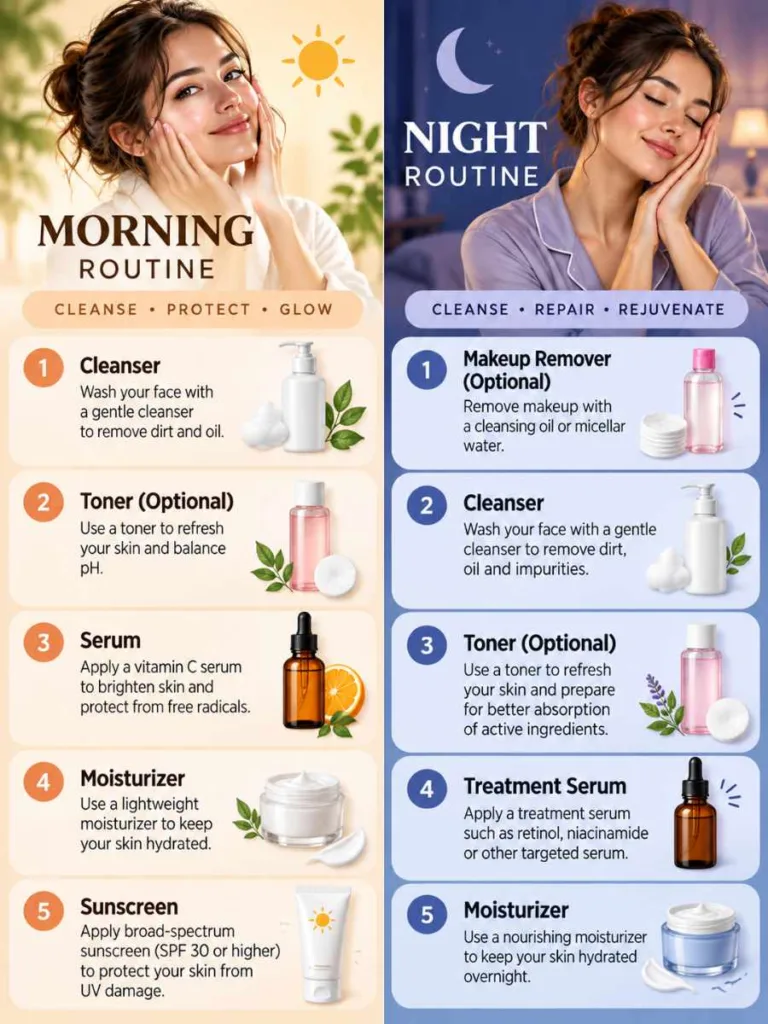
Nighttime is when skin actually repairs itself. This is your window for stronger, active ingredients and richer creams that would feel too heavy under makeup or sunscreen.

At a glance: Makeup Remover/Oil Cleanser → Water-Based Cleanser → Exfoliant (2-3x/week) → Treatment Serum → Eye Cream → Moisturizer → Face Oil (optional)
Makeup Remover or Oil Cleanser
Your evening routine starts with breaking down the day, literally. An oil-based cleanser or dedicated makeup remover dissolves sunscreen, foundation, and the oil your skin produced over ten or twelve hours. Massage it into dry skin first, then add a little water to emulsify before rinsing. Skip this step and go straight to a foam cleanser, and you’ll often leave a thin film of sunscreen or makeup behind, exactly the kind of residue that clogs pores overnight.
Water-Based Cleanser
This second cleanse, commonly called double cleansing, mops up whatever the oil step left behind. It’s a genuine step, not a marketing gimmick. Massage a gentle, water-based formula into damp skin for about thirty seconds, then rinse with lukewarm water. Cold water won’t close your pores, despite the myth, and hot water strips more oil than your skin needs. Pat dry instead of rubbing to avoid irritating skin that’s already a little tired.
Exfoliant
Two or three nights a week, swap your usual routine for a chemical exfoliant instead. Ingredients like glycolic acid or salicylic acid clear away dead skin cells and unclog pores far more evenly than a physical scrub ever could. Apply it to clean, dry skin and let it work for the time listed on the label. Skip this step entirely on any night you’re also using retinol. Stacking two strong actives back-to-back is the fastest route to a red, stinging face by morning.
Treatment Serum
Retinol, niacinamide, or a targeted spot treatment for acne all belong in this step, applied to fully dry skin. These ingredients boost cell turnover, which also makes skin more sensitive to sunlight. The American Academy of Dermatology advises using retinoids only at night for exactly this reason, paired with daily sunscreen the next morning. Start with two nights a week if you’re new to retinol, then build up slowly as your skin adjusts to it.
Eye Cream
Nighttime eye cream tends to be richer than its morning counterpart, built to work while you sleep instead of under makeup. Look for one with peptides or a touch of caffeine if puffiness is your main concern. Apply it once your treatment serum has fully absorbed, using the same gentle, ring-finger tapping motion. This step is small, but skipping it regularly is one reason under-eye fine lines tend to show up earlier than everywhere else.
Moisturizer
A heavier night cream earns its place here, sealing in every layer applied before it. Your skin repairs itself most actively while you sleep, and a rich moisturizer supports that process instead of fighting it. Warm the product between your hands and press it into skin rather than dragging it across your face. If skin still feels tight or flaky by morning, that’s usually a sign this step needs an even richer formula than the one you’re using now.
Face Oil (Optional)
Face oil is the final step for anyone with dry or dehydrated skin, and it’s entirely optional otherwise. A few drops pressed on top of moisturizer seal in every layer underneath and slow down water loss overnight. Because oil can’t really be penetrated by anything applied after it, this always has to come last, no exceptions. Skip it if your skin already leans oily or breaks out easily. One extra step can feel like one step too many.
Give your treatment serum a full two to three minutes to absorb before layering moisturizer on top. Rushing this step is the top reason people see irritation the next morning.
How to Layer Skincare by Skin Type
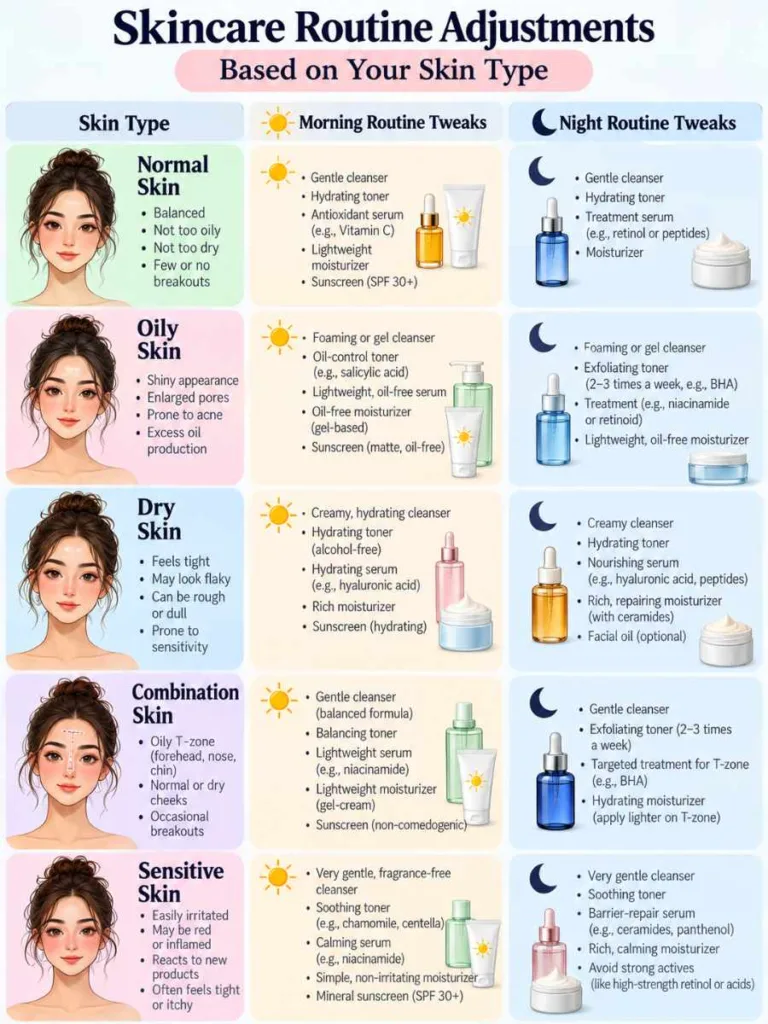
How to layer skincare changes slightly depending on your skin’s needs. Use this quick reference to adjust the standard order above.

By Skin Type
| Skin type | Adjust this way |
| Oily skin | Skip heavy face oils. Use a gel moisturizer and an oil-free, mattifying sunscreen. |
| Dry skin | Add a hydrating essence after toner. Always finish with a face oil at night. |
| Combination skin | Apply lightweight gel moisturizer on the T-zone and a richer cream on drier cheeks. |
| Sensitive skin | Cut the routine down. Skip exfoliants and acids on the same night as retinol. |
No matter your skin type, the core rule never changes. Thin products always go on before thick ones.
By Season
Skin shifts with the seasons, so the order that worked all summer might need small tweaks once it turns cold. Colder air strips moisture faster. That’s why dry and combination skin types often add a hydrating essence or swap to a heavier night cream once temperatures drop. Oily skin types can usually keep the same order year-round, since their oil production stays fairly consistent regardless of season.
Minimalist vs Full Routine: Which Order Fits You
Not everyone wants a nine-step routine, and that’s completely fine. A minimalist routine still works when the order stays correct.
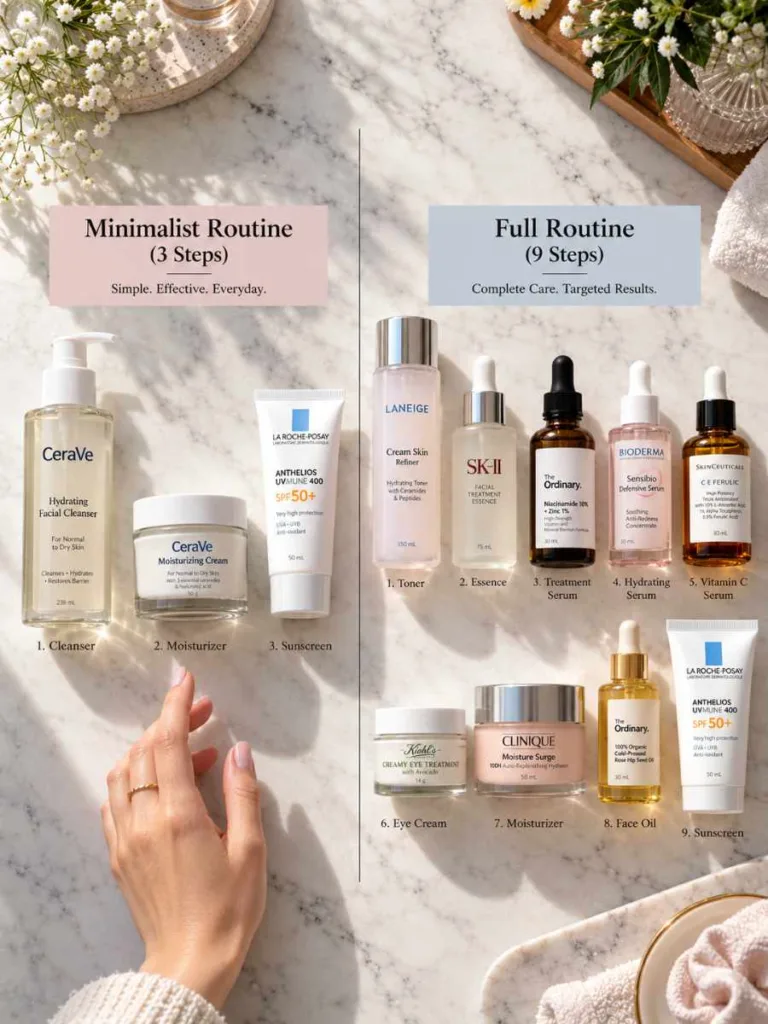
The Minimalist Routine (3 Steps)
Cleanser, moisturizer, sunscreen in the morning. Cleanser and moisturizer at night. That’s it. This covers the basics that matter most, and it’s a routine you’ll stick with.
The Full Routine (7 to 9 Steps)
This version adds toner, serums, eye cream, exfoliants, and treatment products for people targeting a specific concern, whether that’s acne, dark spots, or fine lines. More steps mean more room for something to go wrong, so the order matters even more here.
Best Order for Teens and Beginners
Beginners and teens should start with the minimalist version. Add one new product at a time, then wait two weeks before judging results. That gives skin time to adjust and makes it easy to spot which product is causing a problem if one shows up.
Teens dealing with breakouts often only need four steps: a gentle cleanser, an oil-free moisturizer, sunscreen in the morning, and a spot treatment for active blemishes at night. Adding acids, retinol, or multiple serums before puberty-driven oil production settles down usually causes more irritation than benefit. A simple, consistent routine done daily beats an elaborate one done every once in a while.
10 Common Skincare Routine Order Mistakes
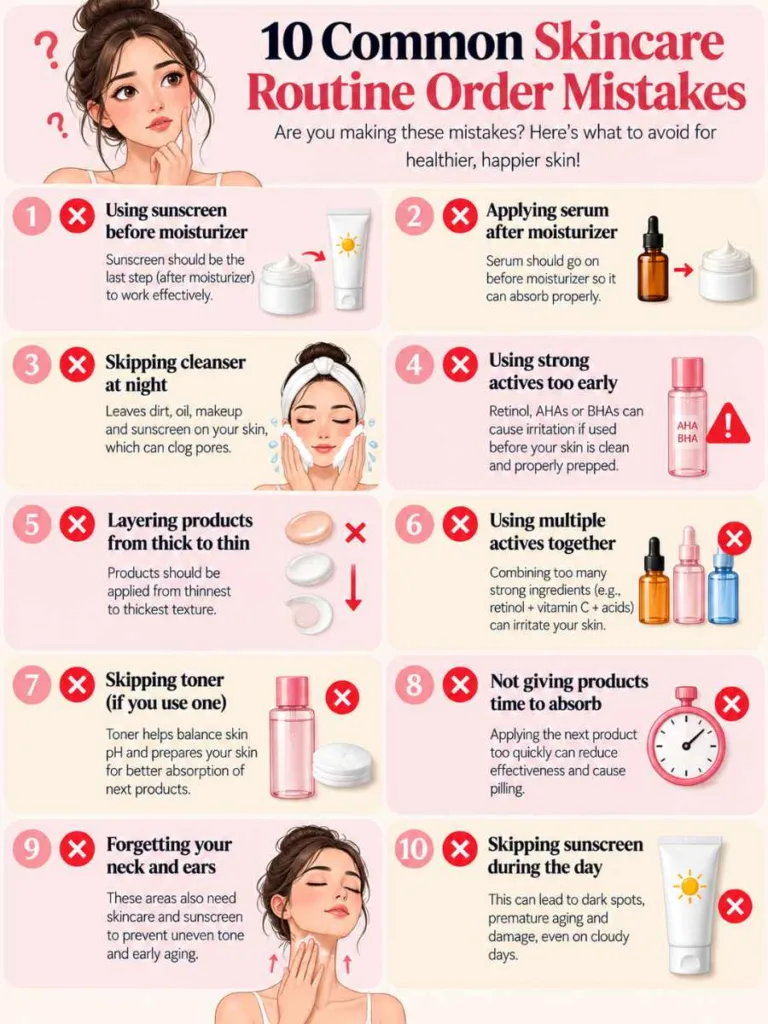
Small ordering mistakes are the reason so many good products fail to deliver results.

- Applying sunscreen before moisturizer. This blocks SPF from bonding to your skin and cuts its protection.
- Skipping the wait time between wet layers. Products mix on the surface instead of absorbing, which causes pilling.
- Using two exfoliating acids on the same night. This strips the skin barrier and causes redness.
- Putting retinol and vitamin C in the same routine. Both are powerful actives that can cancel each other out or irritate skin when stacked together.
- Applying face oil before serum. Oil seals the skin, so any serum applied after it cannot get through.
- Double cleansing every morning. This strips natural oils your skin needs during the day.
- Forgetting eye cream placement. Applying it after a thick moisturizer means it never reaches the thin skin it is meant for.
- Layering too many new products at once. This makes it impossible to know which one is causing a reaction.
- Skipping moisturizer because skin feels oily. Dehydrated skin often produces more oil to compensate, making the problem worse.
- Using the same heavy routine morning and night. Morning needs protection. Night needs repair. Treat them differently.
How Long to Wait Between Skincare Steps
Timing affects absorption as much as order does. As a general skincare layering guide, wait 30 to 60 seconds between watery products like toner and serum. Give treatment actives like retinol two to three minutes before adding moisturizer. Thick creams and oils need no wait time since they sit on top rather than absorbing deep into skin.

If a product pills no matter how long you wait, the formulas likely do not mix well. Try switching the order or spacing that pair across morning and night instead.
Humidity and room temperature also affect absorption speed. Products absorb faster in a warm, humid bathroom right after a shower than in a cold, dry room. If you consistently notice pilling only in winter, try applying your routine in a slightly warmer space or misting your face with water before your serum to help it sink in faster.
FAQ Section
1. What is the correct skincare routine order?
Cleanse first, then apply products from thinnest to thickest: toner, serum, eye cream, moisturizer, and sunscreen in the morning.
2. Does moisturizer go before or after serum?
Serum always goes before moisturizer. Serums carry active ingredients that need direct contact with skin to absorb properly.
3. Why does my skin pill when I apply products?
Pilling happens when a product cannot absorb, usually because it went on too soon after another layer or the formulas just don’t mix.
4. Can I use vitamin C and retinol together?
Use vitamin C in the morning and retinol at night instead of combining them, since both are strong actives that can irritate skin when stacked.
5. How many skincare steps do I actually need?
A cleanser, moisturizer, and sunscreen cover the basics. Add serums or treatments only for a specific skin concern.
Conclusion
Getting your skincare routine order right costs nothing and changes everything your products can do for your skin. You don’t need to buy more. You need to apply what you already own in a sequence your skin can use. Pilling usually eases up within the first week. Visible changes, brighter skin, fewer breakouts, tend to take four to six weeks of consistent use. Start tonight: cleanse, treat, moisturize, in that order, and give each layer a minute to sink in before the next one goes on.
For more skin care tips, please visit VelvetBoard.